 |
Ian (@sirsnapalot) |
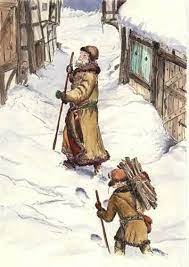
"Good King Wenceslas" is a Christmas carol that tells a story of a Bohemian king going on a journey and braving harsh winter weather to give alms to a poor peasant on the Feast of Stephen (December 26, the Second Day of Christmas). During the journey, his page is about to give up the struggle against the cold weather, but is enabled to continue by following the king's footprints, step for step, through the deep snow. The legend is based on the life of the historical Saint Wenceslaus I, Duke of Bohemia (907–935). The name Wenceslas is a Latinised version of Old Czech "Venceslav".
In 1853, English hymnwriter John Mason Neale wrote the "Wenceslas" lyric, in collaboration with his music editor Thomas Helmore, and the carol first appeared in Carols for Christmas-Tide, published by Novello & Co the same year. Neale's lyric was set to the melody of 13th-century spring carol "Tempus adest floridum" ("Eastertime has come") first published in the 1582 Finnish song collection Piae Cantiones.
Wenceslas was considered a martyr and a saint immediately after his death in the 10th century, when a cult of Wenceslas rose up in Bohemia and in England.[3] Within a few decades of Wenceslas's death, four biographies of him were in circulation.These hagiographies had a powerful influence on the High Middle Ages conceptualization of the rex iustus, or "righteous king"—that is, a monarch whose power stems mainly from his great piety, as well as from his princely vigor.
Sheet music of "Good King Wenceslas" in a biscuit container from 1913, preserved at the Victoria and Albert Museum.
Referring approvingly to these hagiographies, a preacher from the 12th century wrote
But his deeds I think you know better than I could tell you; for, as is read in his Passion, no one doubts that, rising every night from his noble bed, with bare feet and only one chamberlain, he went around to God's churches and gave alms generously to widows, orphans, those in prison and afflicted by every difficulty, so much so that he was considered, not a prince, but the father of all the wretched.Several centuries later the legend was claimed as fact by Pope Pius II ] who himself also walked ten miles barefoot in the ice and snow as an act of pious thanksgiving
Although Wenceslas was, during his lifetime, only a duke, Holy Roman Emperor Otto I (962–973) posthumously "conferred on [Wenceslas] the regal dignity and title" and that is why, in the legend and song, he is referred to as a "king". The usual English spelling of Duke Wenceslas's name, Wenceslaus, is occasionally encountered in later textual variants of the carol, although it was not used by Neale in his version. Wenceslas is not to be confused with King Wenceslaus I of Bohemia (Wenceslaus I Premyslid), who lived more than three centuries later.
{image1}
 |
admin:
@sirsnapalot You did this very well and I really loved and enjoyed it. Awesomeness ❤ ❤❤❤❤
Dec 9th 2021, 8:18 am Report
|
 |
Bev:
@sirsnapalot Hi Ian. Just love your storytelling subs and I think you did a great job on this. Loved my listen this morning. Merry Christmas to you and your family. ♥♫
Dec 10th 2021, 3:26 am Report
|
|
Ian:
@bevb many thanks for listening and I am so pleased you enjoyed it it
Dec 10th 2021, 5:55 am Report
|
 |
Jay Dotson:
Jay455Fabulous well done wonderful story much enjoyed my listen
Dec 10th 2021, 8:41 am Report
|
 |
Len:
....The master of the spoken word speaks again...Love the change of voice Ian...Merry Christmas to you Ian.
Dec 13th 2021, 6:07 am Report
|

 News feed
 Invite
 Images
 Members
 My Ads
 Audios
 Blogs
Blogs K-D Live Chat
 Videos
 Forums